Towards Intelligent Aerodynamic Design: CFD and Machine Learning for Airfoil Optimization
Objective
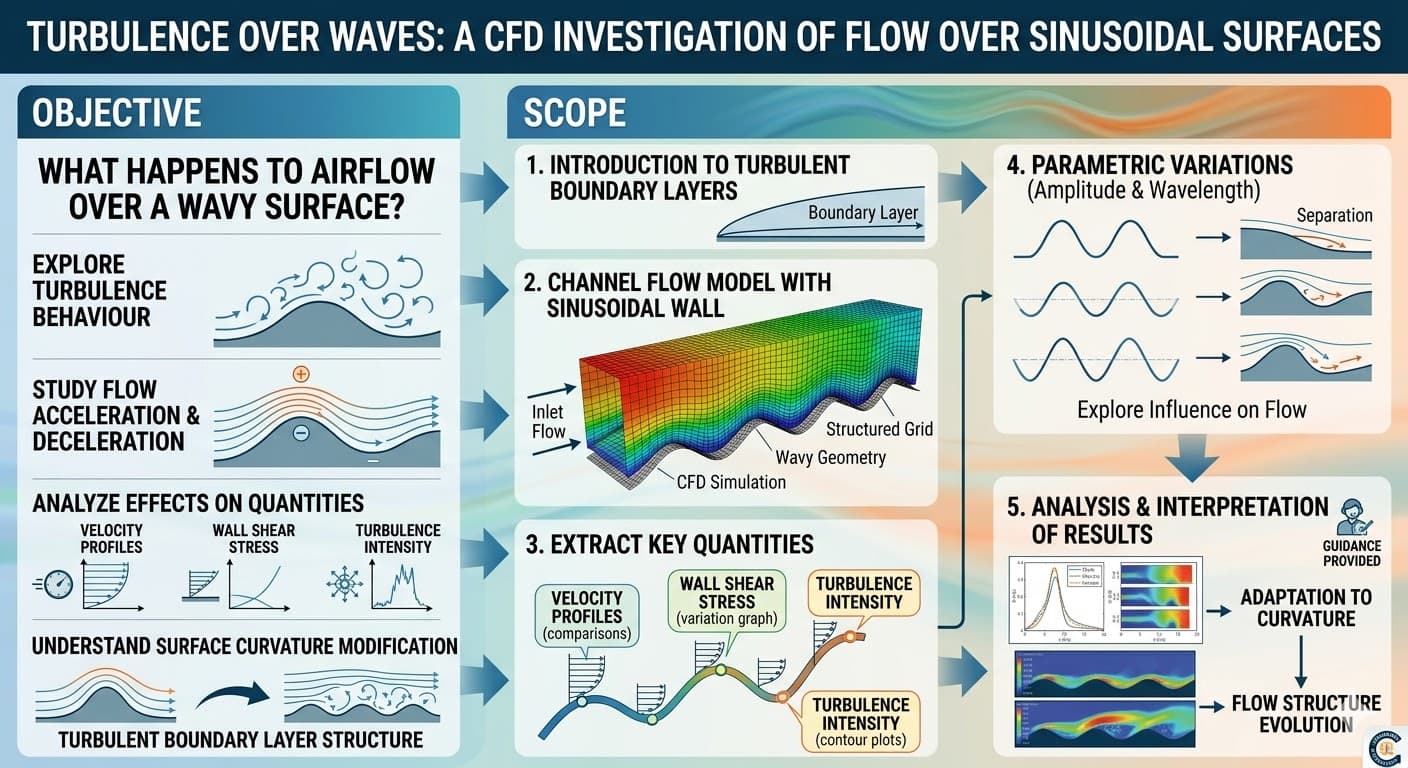
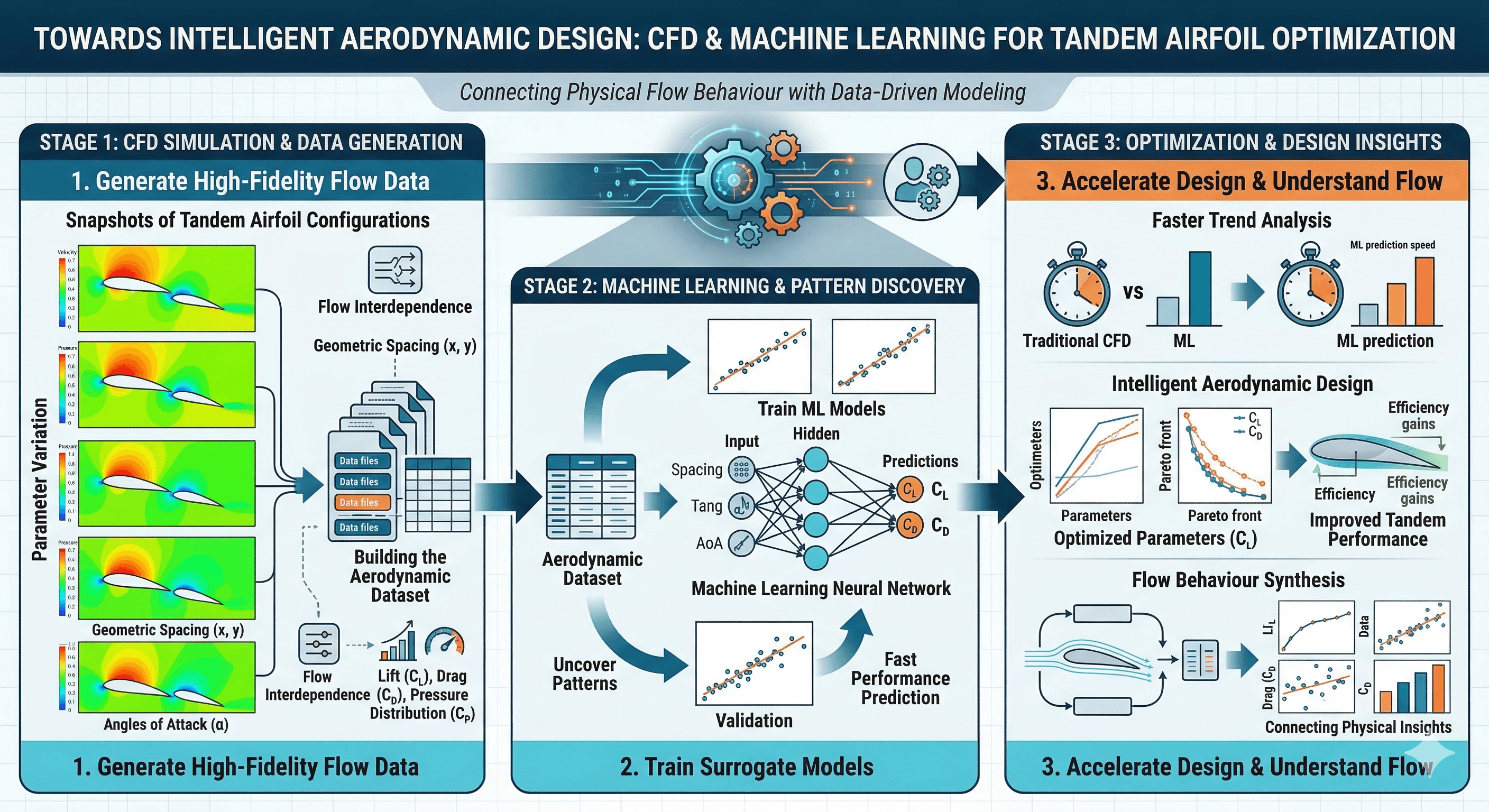
What happens when two airfoils work together instead of one? In this project, you will explore the aerodynamic behaviour of tandem airfoil configurations and study how their interaction influences lift, drag, and flow development. Computational fluid dynamics (CFD) will be used to generate detailed flow data, while machine learning will be introduced as a way to uncover patterns and predict aerodynamic performance across different tandem arrangements. The aim is to connect physical flow behaviour with data-driven modelling, and to see how intelligent tools can help accelerate aerodynamic design.
Scope
The project begins with a structured introduction to CFD and tandem airfoil configurations, where you will simulate flow over two interacting airfoils under different geometric and operating conditions. Parameters such as spacing, relative positioning, and angle of attack will be varied to observe how the flow field and aerodynamic forces respond. From these simulations, a dataset will be built using quantities such as lift, drag, and pressure distribution. Machine learning models will then be developed to learn relationships between configuration parameters and aerodynamic outcomes, allowing faster prediction of performance trends. Throughout the project, guidance will be provided in both the CFD and machine learning components, so that the focus remains on understanding how the two approaches work together.